“I easily WIN the Presidency of the United States with LEGAL VOTES CAST. The OBSERVERS were not allowed, in any way, shape, or form, to do their job and therefore, votes accepted during this period must be determined to be ILLEGAL VOTES. U.S. Supreme Court should decide!” President Trump tweeted at 1:22 a.m. today.
No Hope student is old enough to remember the 2000 election. For instance, I was only two years old, but it has become notorious for being one of the most contentious elections in American history. Unlike the 2016 election and the current tally of 2020 votes, the difference in the popular vote was around 500,000 votes in the 2000 election, instead of millions in 2016 and 2020. “Hanging Chads,” Florida, Pat Buchanan, butterfly ballots and Ralph Nader are all vestiges of the 2000 election. This election, America is dealing with COVID-19, mail-in ballots, social media, Kanye and a newly confirmed Supreme Court justice. What happened in Florida during the 2000 election is similar to what is happening right now in multiple states. Votes are being disputed, lawsuits are being filed and baseless claims of fraud are being thrown around by all sides. The last thing our country needs is for the winner of the election to be decided by the Supreme Court.
Due to COVID-19, the Supreme Court has already weighed in on a few issues regarding vote counting and voting rights during the pandemic. During the primaries in April, the Supreme Court extended deadlines in Wisconsin. Now the Supreme Court seems to have changed course in an even more conservative direction due to the death of Justice Ginsburg and the confirmation of Justice Barrett. Within the last month, the Supreme Court has ruled on lower federal court and state supreme court rulings regarding extensions over the counting of mail-in ballots. Some of these rulings have benefited Republicans, while other rulings favored Democrats.
One of the main reasons why President Trump and Senate Republicans pushed Justice Barrett’s nomination and confirmation through so quickly was in case the election headed to the Supreme Court. President Trump wanted to have a clear conservative majority. Many Democrats viewed this as politically motivated. In the eyes of Democrats, Republicans ignored COVID-19 and ignored passing macroeconomic relief in order to confirm Justice Barrett before the election. Therefore, Justice Barrett is viewed as tainted by politics, just like Justice Gorsuch and Justice Kavanaugh. Justice Gorsuch was able to be confirmed because Republicans left that seat open for many months. Majority Leader McConnell refused to give President Obama’s nominee Judge Garland a hearing. Justice Kavanaugh was confirmed in light of an accusation of a heinous sex crime. Now Justice Barrett was pushed through because President Trump viewed it as politically beneficial. Democrats are fairly asking, “How can these three justices be unbiased if the election goes to the Supreme Court?”
Justice Thomas and Justice Breyer are the only remaining members of the Supreme Court that decided Bush v. Gore (2000). Although only two justices from that Court remain, Chief Justice Roberts, Justice Kavanaugh and Justice Barrett worked on the Bush campaign’s legal team to stop the recount in Florida. Now those justices who worked for the Bush campaign might be asked to rule on a similar case or cases. In an age when the American populace is viewing the Court as more political than ever, the Supreme Court may have to decide the winner of this election. A 6-3 decision with all of the Republican appointees siding with President Trump will be rejected and deemed as political by Democrats and independents. If Chief Justice Roberts, trying to save the institutional reputation of the Court, sides with the liberal bloc, the decision would still be 5-4 in favor of President Trump.
Ideally, the electoral process alone would determine the winner of the election. That is what has happened nearly every American presidential election. Since that is unlikely to occur this time, the only optimal outcome is a unified Supreme Court issuing a decision signed onto by at least 7 of the 9 justices. Unfortunately, that is unlikely to occur, and the Supreme Court will be further viewed as a political, extralegal institution.
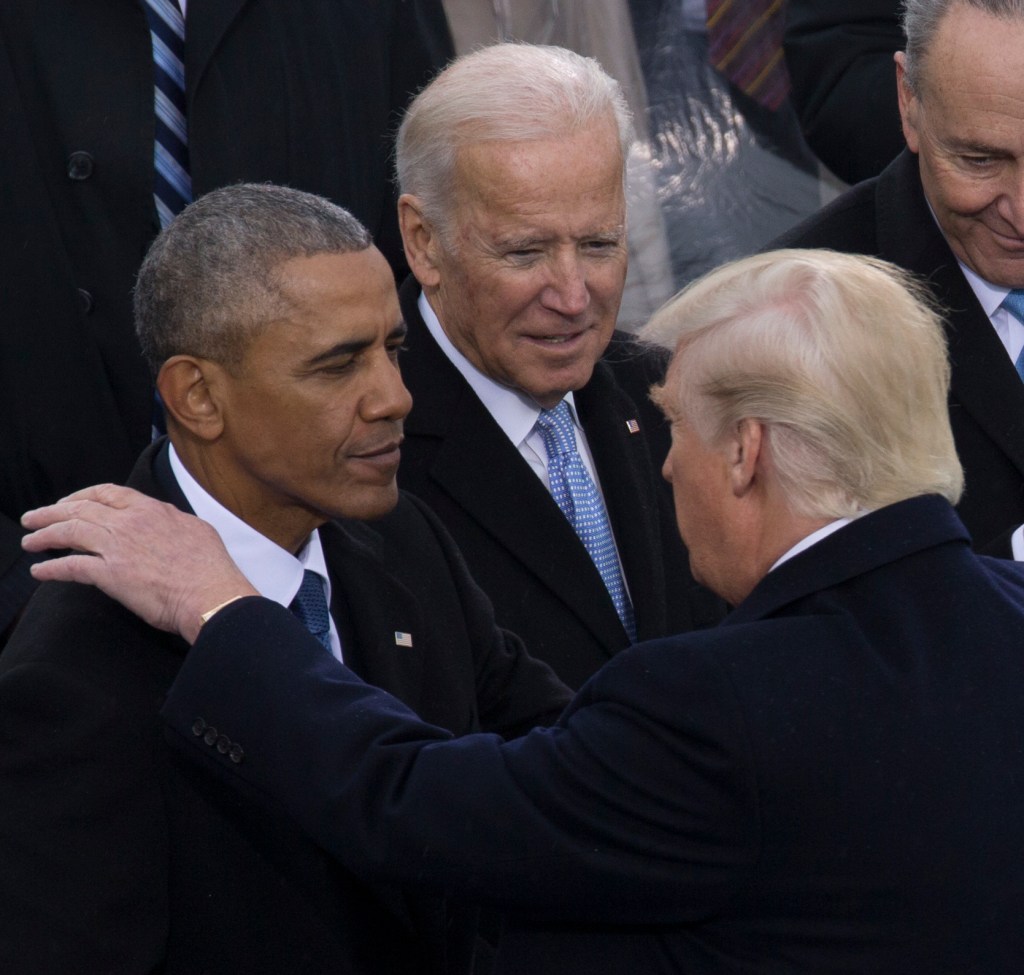
President Donald J. Trump shakes hands with the 44th President of the United States, Barack H. Obama during the 58th Presidential Inauguration at the U.S. Capitol Building, Washington, D.C., Jan. 20, 2017. More than 5,000 military members from across all branches of the armed forces of the United States, including Reserve and National Guard components, provided ceremonial support and Defense Support of Civil Authorities during the inaugural period. (DoD photo by U.S. Marine Corps Lance Cpl. Cristian L. Ricardo)
Due to being the only non-elected branch of our federal government, the Supreme Court usually gets a cursory glance during elections. The American political arena is dominated by the cult of personality. It makes perfect sense that politicians barely mention those stoic judges in black robes. Politicians are too busy screaming about tax cuts, gun control, abortion, and immigration. Although the Supreme Court is less mentioned and less noticed by our politicians, the media, and the general public, it is still a coequal branch of our government. The Supreme Court has always played a role in electoral politics. Conservatives have always worried more about the Supreme Court than liberals. Some scholars attribute this conservative concern to the “liberal” rulings of the Court in the 50s, 60s, 70s, and early 80s. In 2016, the conservative majority on the Court was threatened after the death of Justice Scalia. Majority Leader McConnell refused to hear President Obama’s nominee, Judge Merrick Garland. The majority leader felt the American people should decide the fate of the Court at the ballot box, which further politicized the Court. During the 2018 midterm campaign, President Trump nominated and then the Republican-led Senate confirmed Justice Kavanaugh. Justice Kavanaugh’s confirmation helped the “pink-wave” of female Democrats elected all over the country. As the 2020 election heats up, the Supreme Court will inevitably be drawn into the fray. Here are the top ten ways the Supreme Court will come up in the 2020 election.
Gorsuch, Roberts, Kavanaugh, and RBG Last week, after Bostock v. Clayton County, GA, Zarda v. Altitude Express, and RG & GR Harris Funeral Homes Inc v. EEOC, conservative commentator Ben Shapiro, in frustration over the ruling, called Chief Justice Roberts “the worst Supreme Court Justice of all time.” Shapiro went on to lambaste Justice Gorsuch as well. Republicans are not happy with what they perceive to be “liberal” rulings by the Court this term. On the other hand, Democrats will continue to make Kavanaugh a campaign point. Since Mr. Biden promises to choose a woman to be his running mate, his VP pick and female Democratic congressional candidates will likely continue to criticize that the Republicans confirmed a man accused of a heinous sex crime. Ruth Bader Ginsburg, a liberal icon, is 87 years old and has health problems. If President Trump gets a second term, she will likely die with Trump getting to pick her successor. Democrats will do whatever they can to stop that scenario from happening.
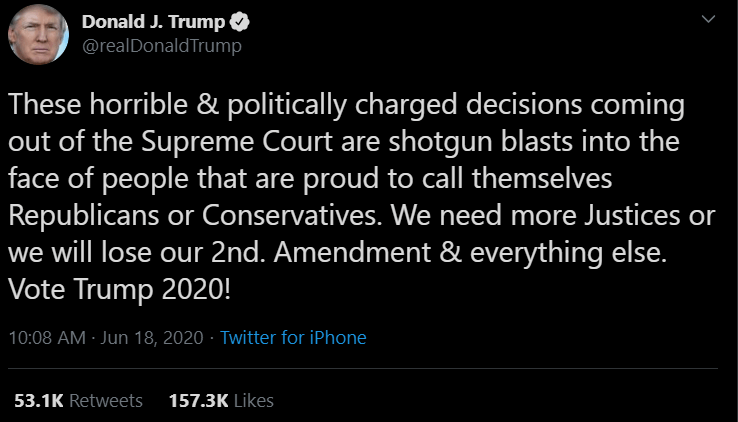
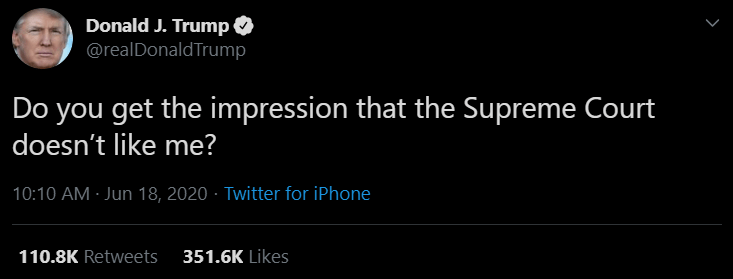
More Conservative Justices and Court Packing After recent defeats at the Supreme Court, President Trump tweeted that we need “more Justices.” Some people interpret this to mean “more conservative Justices” while mostly liberal commentators said Trump was threatening to pack the Supreme Court. They claimed Trump’s tweet was a threat to democracy. I find Democrats accusing President Trump of wanting to pack the Court as ludicrous because some of the Democratic 2020 presidential candidates were openly saying the Court should be expanded with new justices. Pete Buttigieg put forth a plan to pack the Court, and Elizabeth Warren, Cory Booker, Kamala Harris, and Andrew Yang indicated that they were open to the idea of packing the Court. I can talk all day about FDR’s Court packing plan, the “switch in time that saved nine,” why expanding the Court endangers the independence of the judiciary, and why we need a constitutional amendment establishing nine, and only nine, justices. But that’s a story for another day. Fortunately, Vice President Biden said he’s against packing the Court.
Voting Rights After Shelby County v. Holder in 2013, the Voting Rights Act’s power was drastically limited. Now Voter ID laws, purging voter rolls, and voting by mail are politically charged issues. With the coronavirus raging across the states, worries about the 2020 election have crossed the minds of elected officials. Some states have already held primaries under threat of the coronavirus. These states are test runs for how to safely run the general election in November. Many states are turning to vote by mail as a safe solution. Wisconsin had a lot of legal drama in April revolving around the last-minute implementation of their vote-by-mail program and hundreds of voting precincts being closed. The Court weighed in the night before the election on an application for stay of a lower Court order. The Roberts Court has been especially concerned with staying out of issues of gerrymandering and voting. Chief Justice Roberts views those issues as inherently political and therefore out of the purview of the Court. Voting rights are becoming a new battlefront for the culture wars. Expect Democrats to criticize the Court on these issues.
Religious Liberty and LGBT Rights After the recent Court ruling that employers cannot discriminate against members of the LGBT community, conservatives have been fearing the future of religious liberty. Justice Gorsuch addressed this concern in the past few paragraphs of that majority opinion. He said that the Court couldn’t really address religious liberty claims in those cases since the employers based their defense on the “sex” portion of the Civil Rights Act of 1964. It would have been a different matter if the employers’ defense was based on the Free Exercise Clause. More conservatives and more liberals are viewing religious liberty and LGBT rights at odds with each other. Expect this issue and the Court’s jurisprudence in these areas to be a big point of contention in the 2020 presidential and congressional races.
Immigration and DACA Earlier this week, the Court ruled that the Trump Administration violated the Administrative Procedure Act in the way they ended the DACA program. After the ruling, President Trump aired his grievances on Twitter. He vowed to end the program again but in accordance with the Court’s decision. Immigration is one of the main differences between the two parties right now, and putting justices that will protect immigrants will be a top priority for the Democrats. DACA is at risk to be legally ended unless the Democrats take the White House or Congress enshrines legal status for the Dreamers through federal legislation. Democrats taking the White House is more likely than immigration reform passing Congress.
Abortion The Court has yet to rule in June Medical Services LLC v. Russo. That decision will becoming in the next few weeks. This case is almost a carbon copy of Whole Woman’s Health v. Hellerstedt (2016). The factual circumstances regarding the case are eerily similar. The only real difference is the composition of the Court. Logic tells us that the Court will uphold the Hellerstedt precedent and rule in favor of the abortion providers. President Trump and Republicans would ideally like the Court to overturn Roe. This case is unlikely to be the vehicle for the conservative bloc to overturn Roe. If the Court decides to reject the Hellerstedt precedent, they will use this case to start slowly chipping away at Roe and Casey. If the Court rules in favor of the abortion providers again, conservatives will use this ruling as a way to characterize the Court as liberal. President Trump will vow to nominate justices who will overturn Roe. On the other hand, if the Court starts chipping away at Roe, Democrats will use this to prove that they need to take back the White House and Senate to restrict the power of a “conservative” Court.
Obamacare Next term, the Court will hear yet another challenge to the Affordable Care Act. Since the Trump Administration is urging the Court to rule the ACA unconstitutional, Democrats are saying the “heartless Republicans” are trying to take people’s healthcare away during a pandemic. The Democrats are going to use this as another reason to take back the White House and nominate justices willing to uphold the previous Obamacare precedents. Earlier the Court ruled that the individual mandate was constitutional because Congress enacted it as a tax not through the power of the commerce clause. President Trump and the conservatives, who are suing, argue that since the individual mandate tax no longer exists the entire Affordable Care Act is unconstitutional. This will probably be a 6-3 or 7-2 decision upholding the ACA next term, but this will be a major campaign issue for the Democrats.
Qualified Immunity In the late 1960s, the Supreme Court introduced the concept of qualified immunity for law enforcement officers. Qualified immunity intended to protect officers from frivolous lawsuits and financial liability in instances where the officer acted in good faith. In the many years since the late 1960s, qualified immunity has been used to shield law enforcement officers from being held accountable for their actions especially in cases of police brutality. In recent years, the Court has been unwilling to revisit the issue. The Court ideally wants Congress to take up the issue. Since the brutal murder of George Floyd, the country has been engaged in a conversation about police brutality, racism, and the proper role of law enforcement in a free society. Expect Democrats to bring up the Court’s role in establishing qualified immunity and their recent unwillingness to revisit the issue.
Gun Control and Gun Rights The Court has yet to rule in New York State Rifle & Pistol Association Inc. v. City of New York, New York. That decision is coming in the next few weeks. Revolving around restrictions on transporting firearms, this is one of the first big gun cases to reach the Court since Heller and McDonald. The Court will likely rule on the side of gun rights and place legal barriers to future gun control legislation. All the recent mass shootings and the lack of effective legislation in wake of those tragedies will enrage Democrats on the campaign trail. Gun control will be a litmus test for any Democratic president’s nominee to the Court. Any nominee favorable to gun control will be a reason for Republicans to block said nominee. This is an instance of the broader culture wars affecting the Court.
Campaign Finance If Elizabeth Warren or Bernie Sanders were the Democratic nominee, campaign finance would likely be a bigger issue. Campaign finance has fallen to the wayside in light of the coronavirus and police brutality. Although campaign finance is not being talked about as much as it was a few months ago, many Democrats still feel passionately about this issue. Citizens United is not only disliked by Democrats. The majority of Republicans, independents, and the public at large dislike this ruling. The precedent established by Citizens United has led to the perception of “dark money” in politics. Although the American people dislike this decision, only Democrats push this issue. Moderate Republicans, such as Senator John McCain who cared about this issue, have either left or been forced out of the Republican Party.
After the emergence of COVID-19 in America, many states declared a state of emergency. In these emergency decrees were restrictions to many aspects of normal life. One of the main restrictions was changing how people can freely exercise religion. Many states limited how many people could attend church and instituted social distancing requirements within the churches. Many people, especially those on the religious right, view any restrictions on the right to free exercise of religion as unconstitutional. As with all the other rights enshrined in the First Amendment, the right to free exercise of religion is subject to time-place-manner restrictions. Unfortunately, the pandemic clashed with society’s broader culture wars. People viewed these restrictions as big government infringing upon and entangling itself with religion.
This issue came to the Supreme Court in South Bay United Pentecostal Church, et al. v. Gavin Newsom, Governor of California, et al. In this application for injunctive relief, a California church wanted the Court to enjoin enforcement of state restrictions on attendance at religious services. Just as society was politically divided on this issue, the Court was also divided in a 5-4 decision rejecting the church’s request. Unsurprisingly, Chief Justice Roberts was the deciding vote. The Chief Justice ultimately sided with the “liberal bloc” on this highly politicized issue. Weeks before, President Trump declared religious services as essential and called upon the states to allow churches to fully reopen.
The Court rarely gives reasoning for their denial of injunctive relief, but Justice Kavanaugh wrote such a scathing dissent that the Chief Justice must have felt compelled to respond. The Chief Justice wrote that the factual circumstances of the virus warranted Governor Newsom’s actions. The fact that churches are allowed to hold services with up to 25% of building capacity or a maximum of 100 attendees sufficed the Constitution’s requirements. Chief Justice Roberts made clear that the restrictions are more lenient for house of worship compared to the more severe restrictions applied to comparable secular gatherings such as movie theaters and lecture halls.
Justice Kavanaugh’s dissent was joined by Justice Gorsuch and Justice Thomas. Interestingly, Justice Alito would have granted the application but did not join Justice Kavanaugh’s dissent. Justice Alito, therefore, did not give any reasoning for his dissent. In the dissent, Justice Kavanaugh says these restrictions are discriminatory and violate the First Amendment. He says the 25% cap applies to churches but not “comparable secular businesses” such as supermarkets, offices, factories, and marijuana dispensaries. Justice Kavanaugh concedes that California “undoubtedly has a compelling interest” for the restrictions, but the restrictions are not applied evenly to churches and comparable secular matters. “The State may not take a looser approach with, say, supermarkets, restaurants, factories, and offices while imposing stricter requirements on places of worship.” Clearly, the dissenters felt passionate about this issue.
To further complicate matters, the Court issued this rejection as the country was engulfed in rage over the death of George Floyd. Thousands of people were marching in the street. Many of the protesters were not wearing masks or adhering to social distancing standards. This rejection by the Court enraged the religious right. These churchgoers turned on their televisions and saw the protesters exercising their First Amendment rights to free speech and assembly while they felt they could not exercise their First Amendment right to free exercise of religion. This enraged devout churchgoers who could not attend religious services due to the stay at home orders.
Organized religion is easier to curb than the decentralized nature of the protests. People marching in the streets could not be curbed because there was no overarching organization in charge of the protests. People, simply, got out of their home and joined their neighbors in protesting. Government could easily contact churches with the newest rules and regulations of the stay at home orders, but people marching in the streets could not be contacted as easily as religious leaders. Although the right to free exercise of religion is as equally fundamental as the rights to speech and assembly, the decentralized nature of the protests made enforcing time-place-manner restrictions and social distancing requirements nearly impossible. Devout churchgoers viewed the protesters as receiving more favorable treatment. Unfortunately, this created a divide between the protests and religious services. Even though free exercise of religion and free speech and assembly are equally fundamental under the First Amendment, the circumstances of the two situations were completely different.
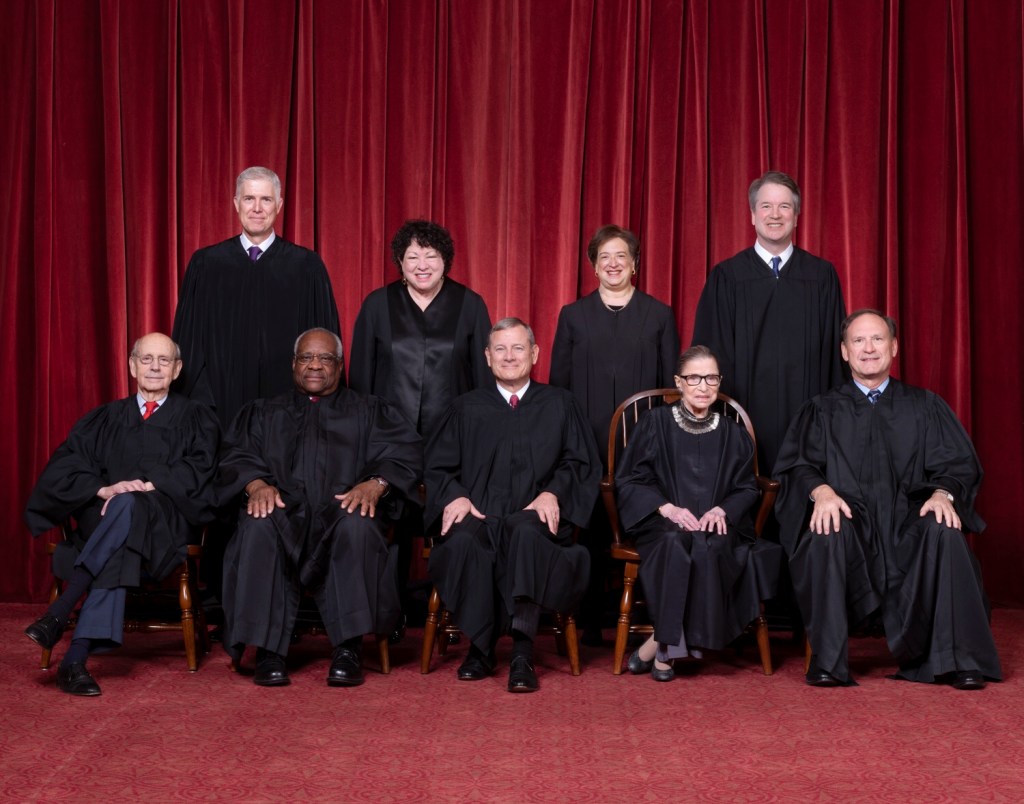
The Roberts Court, November 30, 2018. Seated, from left to right: Justices Stephen G. Breyer and Clarence Thomas, Chief Justice John G. Roberts, Jr., and Justices Ruth Bader Ginsburg and Samuel A. Alito. Standing, from left to right: Justices Neil M. Gorsuch, Sonia Sotomayor, Elena Kagan, and Brett M. Kavanaugh. Photograph by Fred Schilling, Supreme Court Curator’s Office.
After the recent ruling of Bostock v. Clayton County, Georgia, Altitude Express Inc. v. Zarda, and R.G. & G.R. Harris Funeral Homes Inc. v. Equal Employment Opportunity Commission (which were consolidated into one case), the religious right feels betrayed by Associate Justice Neil M. Gorsuch. Conservative Republicans have a long history of feeling burned by Republican appointees to the Court. President Eisenhower felt betrayed by Chief Justice Earl Warren. President Nixon felt betrayed by Justice Blackmun. Conservatives, in the 1980s and 1990s, scorned the “traitors” John Paul Stevens and David Souter. Although Sandra Day O’Connor and Anthony Kennedy usually delivered the outcomes desired by conservatives, Justice O’Connor generally sided with opinions upholding Roe and Justice Kennedy wrote many of the opinions expanding and upholding LGBT rights. Justices O’Connor and Kennedy became responsible for the further denigration of American society in the eyes of the religious right.
As a way to prevent the betrayal of Republican appointees to the Court, conservative legal minds founded the Federalist Society in 1982. Although the Federalist Society’s main goal is to advocate for textualist and originalist interpretations of the Constitution, the overarching goal of the society is to put conservative judges in the federal judiciary and conservative justices on the bench of the Court. Right now, five justices (Roberts, Alito, Thomas, Gorsuch, and Kavanaugh) are current or former members of the Federalist Society. The Federalist Society is closely involved in Republican politics. Due to this relationship, a perception that federal judges and justices, who are a members of the Federalist Society, are Republicans has emerged. Furthermore, just as Democrats view conservative justices as Republican puppets, Republicans view Democratic appointees to the Court as puppets for the Democratic Party.
In order to respect and protect the independence of the Supreme Court, the American public needs to view all nine justices as independent jurists. Republicans cannot scorn Republican appointees when the Court rules against the wishes of conservatives. Likewise, Democrats cannot scorn Democratic appointees when the Court rules against the wishes of liberals. Justice Gorsuch should not be viewed as a traitor by the religious right. Further politicization of the Court for short-term political gains should be dissuaded at all costs. Our independent judiciary is one of the institutional guardrails keeping the other branches in check. If the American public continues to view Supreme Court justices as politicians with an “(R)” or “(D)” next to their name, the balance of power between our three branches will be further denigrated. Justice Gorsuch is not a “traitor” for making what he saw as the correct statutory legal decision. After ruling in favor of LGBT workplace protections in these cases, Justice Gorsuch is being compared to Justice Kennedy. Justice Kennedy was equally disliked by conservatives and liberals. Some commentators are predicting that Justice Gorsuch will become equally disliked by conservatives and liberals. Maybe it would be a good thing if all of the justices were equally disliked by conservatives and liberals. By being disliked by both political factions, the justices could be viewed as above politics, which the Court desperately needs in this hyper-polarized times.
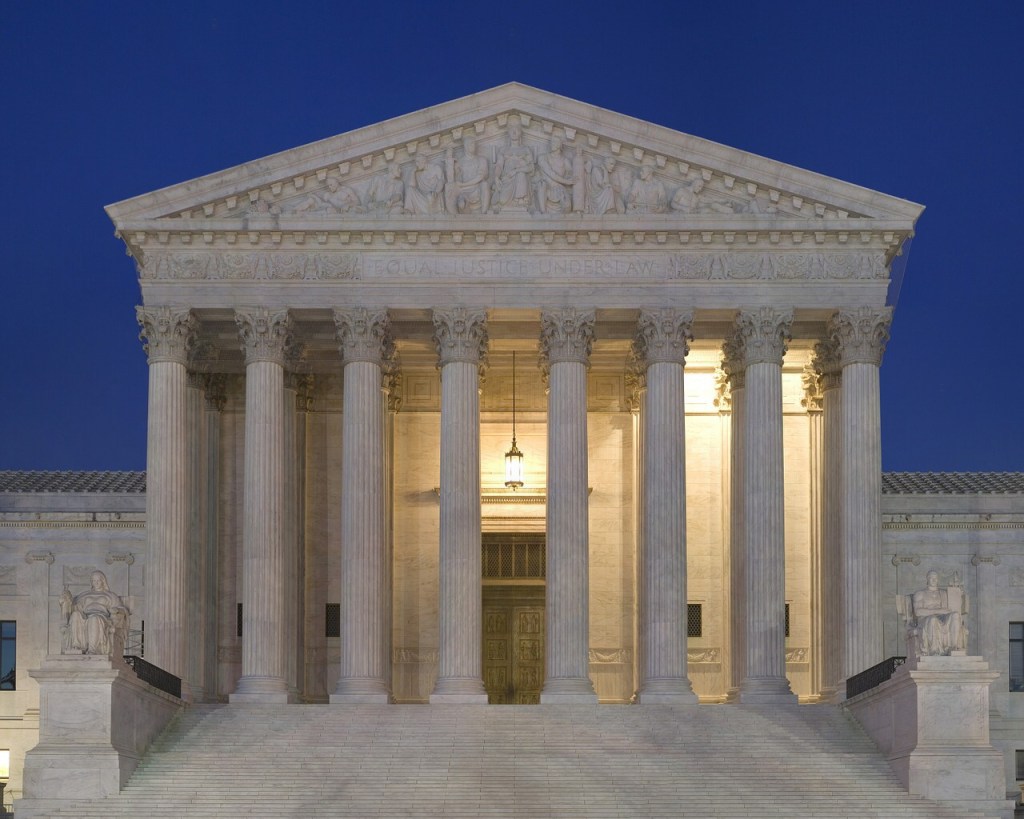
Hi! My name is PJ, and I love the Supreme Court. The Supreme Court operates completely differently than Congress and the presidency. Many view the Court as shrouded in mystery, but the pageantry of the Supreme Court elevates its position in our society. At a time when the public’s faith in Congress and the presidency are at all time lows, the Supreme Court is still highly respected by the American populace even though the Court is increasingly having to stave off accusations of increased partisanship. On this site, I will talk about the cases on the Court’s dockets, grant analysis into the opinions and dissents of the Court’s rulings, and give my opinions on the cases and news revolving around the Court. Thanks for reading!


 The Court and Public Life